
Charlotte Clay Soil Landscaping Guide: Challenges and Solutions
Charlotte clay soil landscaping presents one of the most persistent challenges homeowners in the Piedmont region face. That dense, red clay beneath your yard is notorious for poor drainage, compaction, and making plant life difficult. But with the right knowledge and approach, you can turn even the most stubborn clay soil into a thriving, beautiful landscape. This guide walks you through everything you need to know, from understanding the soil itself to proven solutions that actually last.

What Makes Charlotte's Clay Soil So Challenging?
Charlotte and the surrounding Piedmont region sit on a layer of dense red clay, commonly known as Cecil series soil. Unlike sandy or loamy soils found in other parts of the country, this clay has extremely fine particles smaller than 0.002mm that pack tightly together. The result is a soil that behaves very differently depending on the season.
When it is wet, Charlotte clay swells and becomes slick and plastic-like. When summer heat bakes it dry, it shrinks, cracks, and can become nearly as hard as concrete. This dramatic seasonal movement is at the root of most landscaping failures in the area, from cracked patios to drowned plant roots.
Poor Water Drainage — Clay particles leave very little pore space for water to pass through. After a heavy rain, water tends to pool on the surface for days rather than soaking into the ground.
Soil Compaction — Construction activity, foot traffic, and equipment all compress clay into a hard, impenetrable layer. In many newer Charlotte neighborhoods, the topsoil was stripped during home building.
High Acidity and Nutrient Imbalance — Charlotte clay tends to be acidic with low organic matter content, typically between 1 and 3 percent.
Seasonal Expansion and Contraction — Clay soil can expand by as much as 5 to 10 percent when saturated and shrink back when dry, causing settling, cracking, and structural failure.
How Charlotte Clay Affects Different Landscape Projects
Drainage and Lawn Health
The drainage problem in Charlotte clay yards tends to create a frustrating cycle. Heavy rain arrives faster than the soil can absorb it. Water sheets across the surface, stripping away topsoil and organic matter. Bare patches emerge where grass has drowned or eroded away. And with each successive storm, the bare clay compacts further and the cycle worsens.
Late summer storms intensify this problem. Pop-up thunderstorms common in August and September can dump several inches of rain in a very short window. Even a yard that drains adequately during gentler spring rains can completely flood under these conditions.
Hardscape Installations
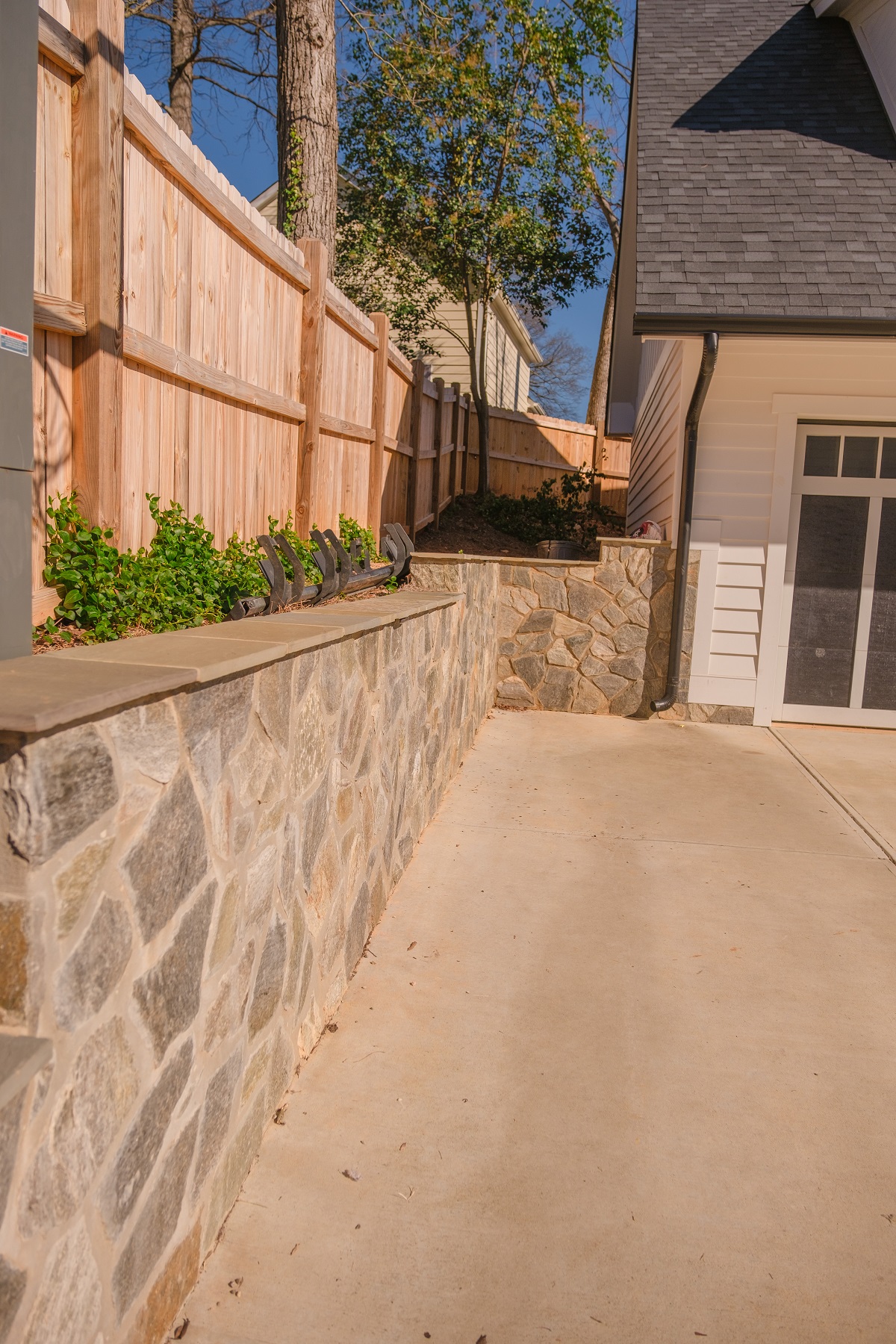
Patios, walkways, retaining walls, and outdoor kitchen pads all face heightened risk from Charlotte's expansive clay. Without deep base preparation and integrated drainage, the seasonal swelling and shrinking of the soil beneath these structures leads to settling, cracking, and in some cases complete structural failure within just a few years.
Retaining walls are particularly vulnerable to hydrostatic pressure, the force of water-saturated clay pushing outward. Walls built without proper drainage behind them can bow outward or topple entirely after a wet winter or spring.
Plant Selection Struggles
Dense clay soil restricts root development, limits oxygen availability, and creates the twin stresses of alternating saturation and drought. Non-native plants that do well in sandy or loamy soils often struggle or fail entirely when planted in Charlotte clay without proper soil preparation.
Proven Solutions for Charlotte Clay Soil Landscaping
Before any planting or hardscape work begins, address how water moves across your property. Proper grading directs runoff away from foundations and structures toward safe outlets. For persistently wet zones, French drains are a highly effective solution — a gravel-filled trench with a perforated pipe that collects subsurface and surface water and redirects it away from problem areas.
The single most impactful thing you can do for Charlotte clay is consistently add organic matter. Compost, aged leaf mulch, and well-rotted manure all work to bind with clay particles, creating better soil structure with more pore space. For existing lawns, core aeration paired with compost top-dressing is the most practical approach. For new planting beds, tilling 3 to 4 inches of compost into the top 6 inches of soil before planting gives plants a much better start.
Native plants that evolved alongside Charlotte's red clay naturally perform better in local conditions than non-native species. These plants have developed root systems suited to the alternating wet and dry cycles of Piedmont clay.
Strong performers for Charlotte clay soil landscaping include:
Any hardscape project in Charlotte clay requires deeper base excavation than might be standard elsewhere. The base material must be compacted in lifts, drainage must be integrated from the start, and flexible installation techniques with proper expansion joints must be used. Flexible paver systems generally outperform rigid concrete in expansive clay conditions.
Maintaining Your Charlotte Landscape Long-Term
Clay soil improvement is not a one-time project. It is an ongoing process. Annual core aeration, consistent compost top-dressing, and mulching planting beds each season all contribute to gradual but meaningful soil improvement over time.
Pay attention after heavy rains. If you notice standing water in the same spots repeatedly, soil erosion forming channels, or bare patches where grass struggles to establish, these are signs that deeper drainage or soil amendment work may be needed before the problems compound further.
Final Thoughts
Charlotte clay soil landscaping is never a simple undertaking, but it is absolutely manageable with the right approach. The homeowners who see the best long-term results are those who invest upfront in proper drainage, consistent soil amendment, and smart plant selection rather than trying to shortcut the process. A landscape that works with the characteristics of Charlotte's clay will reward you with durability, beauty, and far less frustration every time a summer storm rolls through.